By Dan Spalding
News Now Warsaw
WARSAW — Warsaw Mayor Jeff Grose rolled out an ambitious plan for the long-term multi-million dollar renovation of Winona Avenue with a group of business owners.
The work would stretch from the Argonne Road roundabout and continue west to the railroad tracks near SR 15.
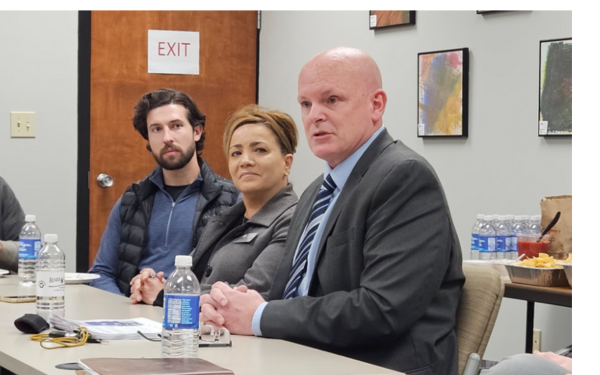
Tuesday’s meeting at the Kosciusko Chamber of Commerce offices was hosted by Winona Avenue Business Association, a relatively new group that is spearheading the drive for improvements. Among those attending were representatives of Grace College and Orthoworx, which are both helping finance the project.
Grose describes it as a large-scale infrastructure project that will take years to complete and compares it to the Anchorage Road reconstruction, which began about eight years ago, with construction set to begin this spring.
The project will rely, in part, on multiple sources of money, including large sums from Grace College and Orthoworx.
Orthoworks has pledged $1 million from its Orthopedic Industry Retention Initiativeand Gracce College has committed $1.7 from its $27 million Catalyst Corridor fund made availsble throughmoney provide by the Lilly Endowment.
Emi Kreklau, executive director of the Corridor fund, said other portions of the overall money will be used for other road improvements near the campus, and that the college is supporting the Winona Avenue plan even though it is outside of Winona Lake, because it’s a key transportation route that serves the community.
A $200,000 study that focuses significantly on utilities is underway, and another, more detailed meeting about the overall plan will happen this summer, Grose said.
“This study is going to show you it will not look the way you’re seeing it now, and with that will be consequences that will change everybody’s view and the realities of it,” Grose said. “And I hope, with our help and other stakeholders – most importantly, you, we’ll be able to come up with something that will work.”
The project would be done in phases, and Grose, who has said the project is a top priority, said he prefers to see the work start near the roundabout and head west.
“We might be able to see a phase that could maybe be started in the spring or summer of 2028,” Grose said.
“There’s a lot of work, whether you see it or not, that is going to have to be done, and a lot of money, a lot of effort,” he said.
The numerous business owners who attended the meeting applauded the proposal.
And while they also understand it will be a lengthy and challenging process that could take many years, a few urged the city to address the existing poor conditions of the road, mainly potholes.
Doug Hanes, a local banker, pointed out one disparity in the city’s road repair program.
He pointed out that the city has repeatedly performed road improvements on nearby east-west roads, including Fort Wayne, Main, Center, and Market streets, while Winona Avenue – which carries far more traffic than Center Street – seems to receive very little attention.
Linda Devins, a business owner, said money needs to be set aside for the road in the meantime.
“There has to be a budget for repairs and Maintenance to keep it up — it’s gotta be in the budget,” Devins said.
Hanes suggested the city should consider creative options to find the money.
“There could be a way to do some maintenance on Winona with repaving and stripping the way we’ve respectfully treated other streets that are parallel that get much less traffic,” Hanes said.
Grose did not specifically address the idea of a dedicated maintenance program, but urged city residents repeatedly to reach out to the public works department or his office so they are aware of problems.
In some circumstances, such as a large pothole, documenting it with a photo could also help, Grose said.
“Call my office. I’m not kidding you. It will get attention … It has to,” Grose said. “And if not, you need to talk to the local media outlets.”