

By Casey Smith
Indiana Capital Chronicle
Indiana’s new school accountability system is officially on the books, pending a few final signatures.
The State Board of Education on Wednesday voted unanimously to formally adopt the new statewide model, locking in a redesigned A-F grading system that state officials said better reflects student progress, literacy and post-graduation readiness.
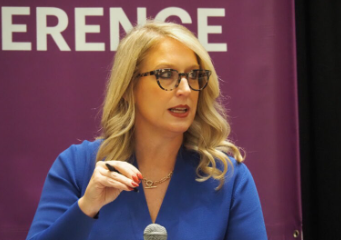
“This has been something that has been a long time coming,” said Katie Jenner, Indiana’s secretary of education. “Many, many stakeholders around Indiana weighed in.”
The multiyear effort was ordered by lawmakers after Indiana dismantled its previous accountability framework and rewrote high school graduation requirements. Schools have been without a grading system in the interim while the replacement model was in development.
The rule now heads to state Attorney General Todd Rokita, who has 45 days to sign off, and then to Gov. Mike Braun for final approval.
“This model values academic outcomes as well as skills and experiences. It’s so much more than just creating a robot who can memorize things,” said Paul Ketcham, assistant secretary of education. “It is a very granular model. Every student will have the opportunity to grow, and it’s our responsibility to grow them.”
“In 49 other states, it’s an accountability rule,” Ketcham said. “In Indiana, it’s a roadmap for schools and students and families to be successful.”
A familiar framework — with a rebuild
Indiana schools will continue to receive single-letter grades — A, B, C, D or F — under the new system, but those grades will now be calculated in a fundamentally different way.
Rather than relying primarily on schoolwide averages and standardized test scores, the new framework assigns points student by student. Jenner and other education officials have described it as a model in which schools earn credit for each individual student based on a combination of academic proficiency, growth and additional “success indicators” that vary by grade span.
Those student-level scores are averaged within separate grade bands — elementary, middle and high school — and combined into one overall A-F grade for each school.
The model was intentionally designed to move beyond an “all-or-nothing” approach and incorporate multiple measures while keeping academic mastery central, particularly reading and math in the early grades, according to a state regulatory analysis.
“No longer does an indicator encourage schools to dismiss certain students that might be way behind,” said Ron Sandlin, senior director of school performance and transformation for the Indiana Department of Education. “We fundamentally flipped the paradigm. Every student in a school generates points.”
At the high school level, the model more directly ties accountability to Indiana’s newly redesigned diplomas and diploma seals.
Graduation rate and SAT performance each make up 10% of a school’s grade-12 score, alongside measures tied to coursework, credentials, work-based learning and student engagement.
“What we’ve tried to do is understand the student in their entirety,” Jenner said. “So that they don’t get washed in simple numerator-denominator math that we’ve been doing for so long.”
Multiple education groups and other board members additionally voiced support during Wednesday’s meeting.
“This framework gives teachers the tools to celebrate and support success beyond a single test score,” said Rachel Hathaway, Indiana executive director at Teach Plus, a national nonprofit focused on education policy. “Accountability should not be about labeling schools. It should be about improving them.”
Todd Bess with the Indiana Association of School Principals emphasized that the new model “prioritizes student growth alongside proficiency.”
“It recognizes the progress schools make every day with students at all starting points. Moving up those that are below (proficiency). Those that are just about there — and then obviously, those that are still wildly proficient — keep moving them, too, and finding those success indicators,” Bess said. “Families and communities can better understand school performance … and what I like is we can say we’re going to add these things up. Every kid matters, and here’s the greatest outcome.”
A transition year before grades ‘count’
The new accountability system will roll out through a transition period Sandlin tagged “Year Zero,” which applies to the 2025-26 school year.
Letter grades for the current academic year will be calculated and publicly released under the new model, but they will be informational only and will not trigger any timelines or consequences tied to Indiana’s accountability laws.
Sandlin said that the goal is to give schools and communities time to understand the new calculations and respond before the grades formally carry weight. Year Zero, he said, is intended to “set a clear baseline” and provide families and schools with transparent information about where performance stands under the new system.
IDOE plans to begin sharing detailed performance data with schools later this year, followed by the public release of Year Zero grades.
“This is different than any past A-F years,” Sandlin said.
As part of the transition, the grading scale will also be temporarily adjusted. For Year Zero, an A grade will span 85 to 100, rather than the traditional 90 to 100 range.
Starting with the 2026-27 school year, letter grades will once again count for accountability purposes. At that point, the cutoff for an A will gradually increase over time, rising by 2.5 points in any year when at least 25% of schools earn an A, until it reaches a final target of 90 to 100.
State officials said the approach is intended to allow an initial transition period while steadily increasing rigor as schools improve under the new model.
Wednesday’s vote followed months of revisions and public feedback led by IDOE, as well as parallel negotiations with federal education officials over Indiana’s accountability obligations.
Jenner said the state hit pause on its pending federal waiver — which would give Indiana added flexibility in how it aligns accountability and funding — to avoid locking in a model that was still being revised.
The waiver seeks permission from the federal government to overhaul how Indiana spends and tracks billions of dollars in education aid — a request that Hoosier officials said would align the state’s accountability system with federal law and allow more freedom in how schools use their funds.
Hoosiers officials specifically requested exemptions from multiple provisions of the Elementary and Secondary Education Act, or ESEA, the federal law governing K-12 education, plus permission to combine funding from more than 15 federal education programs into a single “strategic block grant.”
The U.S. Department of Education has 120 days to review and respond to waiver applications once they’re received. Indiana’s was submitted in October, but the pause extends that timeline.
“We intentionally paused our federal waiver process as we were working through the final touches in our accountability model …. in order to get this at the best place,” Jenner said. “We will unpause our waiver timeline shortly.”
“The fact that we’re doing this accountability work simultaneously as we’re working on our waiver has been a huge advantage to Indiana,” she said. “In addition to stakeholders in Indiana pushing us on some things, (federal officials) have also pushed us on some things. … A lot of people think policy work is threading the needle. We’ve had, like, multiple pieces of yarn.”
* * *
The Indiana Capital Chronicle is an independent, nonprofit news organization dedicated to giving Hoosiers a comprehensive look inside state government, policy and elections. The site combines daily coverage with in-depth scrutiny, political awareness and insightful commentary.