

Associated Press
The federal government is reopening, but there’s still uncertainty about when one of the most far-reaching impacts of the closure will be resolved and all 42 million Americans who receive SNAP food aid will have access to their full November benefits.
President Donald Trump signed the reopening measure Wednesday.
One provision calls for restarting the Supplemental Nutrition Assistance Program, but it doesn’t resolve when the benefits will be loaded onto the debit cards beneficiaries use to buy groceries.
A spokesperson for the U.S. Department of Agriculture, which runs the program, said in an email Wednesday that funds could be available “upon the government reopening, within 24 hours for most states.” The department didn’t immediately answer questions about where it might take longer — or whether the 24-hour timeline applies to when money would be available to states or loaded onto debit cards used by beneficiaries.
 There has been a series of court battles over the fate of the largest government food program, which serves about 1 in 8 Americans.
Here are things to know about how it could go.
When will SNAP become available?
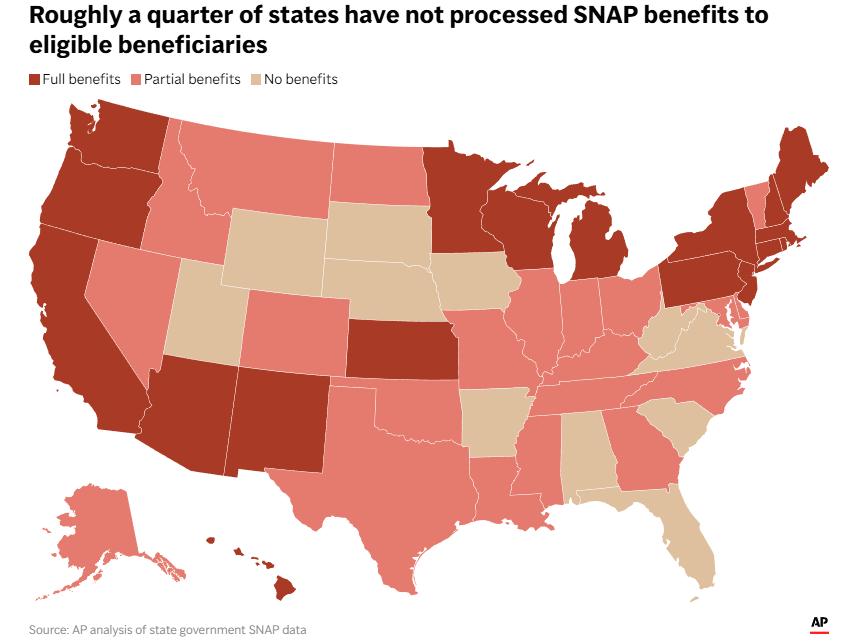
Seesawing court rulings and messages from the USDA have meant that beneficiaries in some states already have received their full monthly allocations, while in others they have received nothing. Some states have issued partial payments.
States say it’s faster to provide full benefits than it is to do the calculations and computer programming required for partial amounts.
At least 19 states plus the District of Columbia issued full benefits to at least some recipients last week, an Associated Press tally found. Many of them managed to do it in a day or so, in the narrow window between the Nov. 6 court ruling that required the federal government to make full payments and one Nov. 7 by the U.S. Supreme Court that stopped it.
Jessica Garon, a spokesperson for the American Public Human Services Association, said she anticipates most states will be able to issue full benefits within three days after they’re given the go-ahead, but that it might take a week for others.
Update on flight restrictions
Flight reductions at 40 major U.S. airports will remain at 6% instead of rising to 10% by the end of the week because more air traffic controllers are coming to work, officials said Wednesday.
The flight cuts were implemented last week as more air traffic controllers were calling out of work, citing stress and the need to take on second jobs — leaving more control towers and facilities short-staffed. Air traffic controllers missed two paychecks during the impasse.
The Department of Transportation said the flight reduction decision was made on recommendations from the Federal Aviation Administration’s safety team, after a “rapid decline” in controller callouts.
The 6% limit will stay in place while officials assess whether the air traffic system can safely return to normal operations, Transportation Secretary Sean Duffy said, although he did not provide a timeline Wednesday.