By Dan Spalding
News Now Warsaw
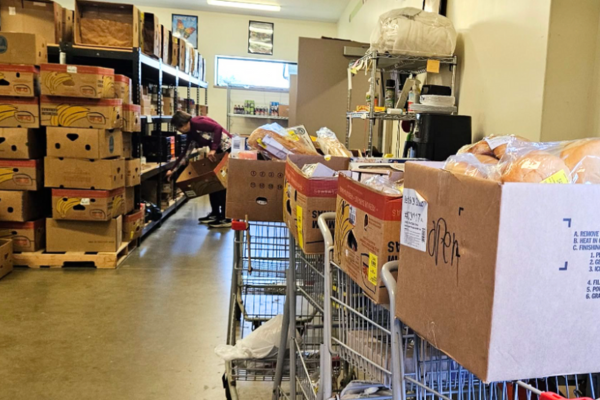
WARAW — Monday was a busy, busy day at Combined Community Services, with many people standing in line to sign up for food assistance while others browsed for free coats provided after the recent Kerlin Family Coat Drive.
The first of the month is always busy, but Monday was different after SNAP benefits began to expire over the weekend, a result of the ongoing government shutdown.
The CCS pantry serves about 900 families per month, but that is expected to rise in November as about 1,800 families in Kosciusko County realize SNAP benefits have expired.
Churchill said they saw several SNAP recipients on Monday at the CCS food pantry who had never relied on CCS in the past.
At the same time, the non-profit has seen single-day records for assistance in the past two months, according to Kiira Churchill, executive director for CCS.
She attributes that to inflation and increased word-of-mouth about CCS services.
“We’ve definitely seen an uptick already, but then to add an additional layer of desperation, I would say, with some of these families who are contemplating, ‘How are we going to get through the month without this benefit I had anticipated,'” Churchill said, adding that the families only had a week to make adjustments and preparefor lack of SNAP benefits.
“Our hearts were all preparing and our minds were preparing for a large need … for individuals … who have never come in and used our services before,” Churchill said.
Calls for more assistance come at a big time for CCS.
Family sign up for the annual Adopt A Family program for Christmas begins Wednesday, and the two-day Food-A-Thon at CCS is Friday and Saturday.
She says while there is more demand for food, they’re also seeing more support from the community to keep the pantry operating.
“We’ve seen an increase in donations specifically for food for our food pantry, which is going to make a huge impact for us,” she said.
Exactly what happens in the coming weeks depends on Congress as the shutdown, now in it’s 35th day, becomes the longest ever.
Two days after court rulings supported sustaining SNAP during the shutdown, President Donald Trump’s administration said Monday that it will partially fund SNAP after a pair of judges’ rulings required it to keep the food aid program running, according to a report from Associated Press.
But uncertainty remains.
The U.S. Department of Agriculture had planned to freeze payments to the Supplemental Nutrition Assistance Program starting Nov. 1 because it said it could no longer keep funding it due to the shutdown. The program serves about 1 in 8 Americans and is a major piece of the nation’s social safety net. It costs about $8 billion per month nationally.
It’s not clear how much beneficiaries will receive, nor how quickly beneficiaries will see value show up on the debit cards they use to buy groceries. The process of loading the SNAP cards, which involves steps by state and federal government agencies and vendors, can take up to two weeks in some states. The average monthly benefit is usually about $190 per person.
The U.S. Department of Agriculture, which oversees the nation’s largest food program, said last month that benefits for November wouldn’t be paid out due to the federal government shutdown. That set off a scramble by food banks, state governments and the nearly 42 million Americans who receive the aid to find ways to ensure access to groceries.