
By Leslie Bonilla Muniz
Indiana Capital Chronicle
Ambitious electric service affordability legislation faced dozens of recommendations for improvement Tuesday — from lawmakers and lobbyists alike — across a two-hour hearing.
House Bill 1002, a House Republican priority proposal, would reshape utility providers’ low-income customer assistance programs, block service shut-offs to such customers on dangerously hot days, put all ratepayers on predictable billing plans and refashion ratemaking into three-year plans outfitted with performance-based incentives.
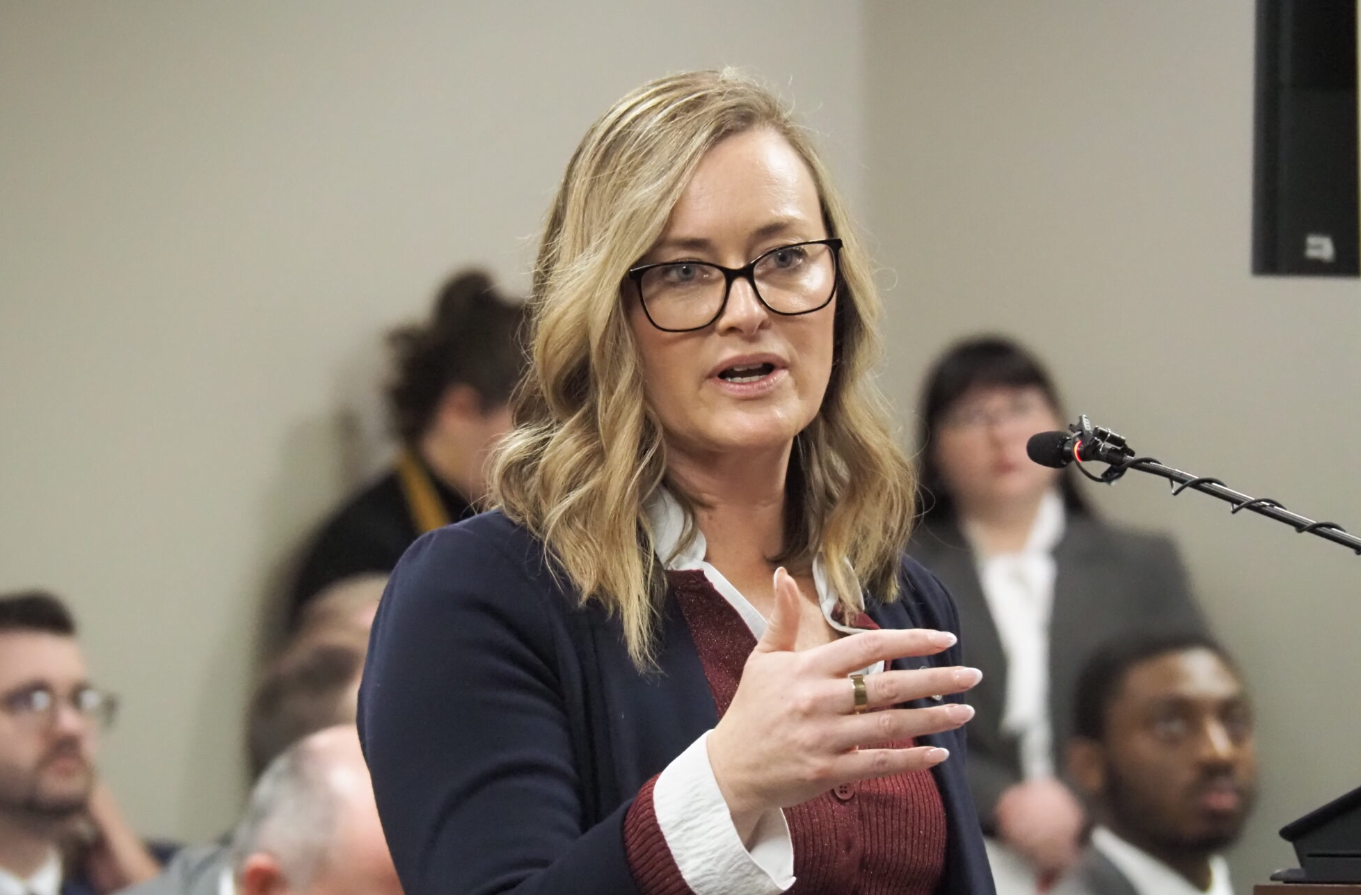
“The goal … is to prioritize affordability for Hoosier ratepayers and ensure our utilities are maintaining transparent, cost-effective practices,” the bill’s author, Rep. Alaina Shonkwiler, R-Noblesville, said in a statement after Tuesday’s committee meeting.
“Any potential changes to the bill will align with those goals,” she continued.
Only testimony was taken in in the House’s utilities committee on Tuesday, with amendments and a vote expected next week.
Advocates like Delaney Barber Kwon of Indiana Conservation Voters thanked Shonkwiler for her work but suggested “further clarification in order for intent to match implementation.”
The legislation would require electricity suppliers under Indiana Utility Regulatory Commission jurisdiction that don’t already offer low-income customer help programs to do so by July. The companies would fund those offerings to at least half the amount they recovered from ratepayers under their IURC-approved energy efficiency programs in the most recent year.
Luke Wilson, the chief policy officer of the Indiana Office of Energy Development, estimated that could direct up to $30 million annually to low-income Hoosier households.
“That is a cost shift that is already in bills,” he added, “so ratepayers are not feeling additional impact.”
The provision encountered mixed testimony.
Danielle McGrath, president of the Indiana Energy Association, said lawmakers shouldn’t use that funding mechanism because the revenue varies by utility and by year, while Kerwin Olson, executive director of Citizens Action Coalition, said it’s “more than adequate funding.”
Committee Chair Rep. Ed Soliday, R-Valparaiso, noted the money has to come from somewhere, lest the bill be caught up in the finance-focused Ways and Means Committee.
Rep. Matt Pierce, D-Bloomington, and others pushed for greater regulator oversight of the program requirements instead of leaving it largely up to the utilities themselves.
The legislation would require providers to notify customers of assistance programs on their websites. Rep. Cherrish Pryor, D-Indianapolis, asked that the text also go directly on bills to better reach elderly ratepayers.
“My daughter is my parents’ IT support, so I appreciate your point,” Shonkwiler joked.
Another provision intended to ease the burden on low-income Hoosiers would mimic current policy banning winter electricity service shut-offs — from Dec. 1 to March 15 — to the summertime. A key difference, however, is that the pause would be triggered by federal extreme heat warnings instead of taking effect across the hottest months of the year.
Pierce and customer advocates argued a month-based approach would be simpler to administer and benefit customers more.
“We need to be really careful (that) we just don’t pile up four months of debt on these people, and now they’re looking at trying to get reconnected, and the price is so high they can’t do it,” Soliday replied.
Debt fears also arose in detailed discussion over so-called budget billing plans, which promote predictability for customers by holding monthly bill amounts steady despite changes in usage. But when utilities settle up, shocked customers may find themselves on the hook for large sums.
“Families think they’re being on a program to help stabilize their finances, and they feel like they’re being preyed upon,” said Rep. Alex Burton, D-Evansville.
Pryor suggested a name change.
“I think part of what’s confusing the people is they hear ‘budget billing,’ and they think … there is a savings,” she said. “So, maybe, the word ‘budget’ needs to be changed to something that’s more reflective of what it really is.”
“It is confusing,” Soliday agreed. “… It doesn’t save you money. It saves you from spikes, is what it does. And some folks can endure spikes, and (for) others, it’s really painful.”
House Bill 1002 would require that every customer be put on such plans, but be given the ability to opt out. Utilities would settle up with participants at least twice a year, in an effort to avoid the sticker shock of a once-annual true-up.
Several witnesses recommended removing “at least” from the legislation to ensure true-ups don’t occur so often they erode the predictability budget billing is supposed to bring. Other suggestions included limiting implementation to just low-income customers, adding more detail on when the debt is due and pushing the effective day back from July.
Bill explores longer rate cycles, incentives
The measure would also switch up Indiana’s traditional ratemaking process by requiring utilities to pursue IURC approval of multi-year rate plans. The first year would be done “in the same manner” as now, while the second and third years would be based on projections.
Although Soliday said the intent was to make utilities file the same detailed information as is currently required, some warned the language may not be explicit enough.
Joe Rompala, representing the Indiana Industrial Energy Consumers, also testified there’s no mechanism to settle the difference between the projected data and what actually transpires.
“This helps ensure that customers are only paying for assets which have actually been put into service, and which are actually being used to serve them when rates go into effect,” Rompala said. “This upholds a longstanding legal principle which helps shield ratepayers from excessive investment, which generates no direct benefits to them.”
Pierce and several witnesses objected to language specifying that the multi-year rate plans operate “independently” of trackers — requiring that regulators consider them “separately.”
Trackers allow utilities to increase rates based on certain expenses they have.
Sam Carpenter, the executive director of the Hoosier Environmental Council, feared that could “undermine some of the cost-containment goals.” He asked for lawmakers to clarify the “interaction” between those mechanisms.
Soliday previously said some trackers may “disappear” if multi-year ratemaking is adopted, telling the committee, “I’ve had some (utilities) say to me, they may just drop (the Transmission, Distribution, Storage Improvement Charge) completely, because it works into the plan.”
The multi-year rate plans would be paired with new performance metrics and incentives tied to customer affordability and service restoration.
Several witnesses suggested incentivizing additional priorities, like reducing peak load demand or promoting environmental sustainability. Others asked that the incentives be tailored to specific utilities or said the proposed incentive range is too small to drive utility decision-making.
It’s unclear which chunks of the bill could get the biggest revisions.
“I appreciate everyone who testified in the committee today and expect any amendments put forth to reflect the valuable insights and feedback we continue to receive from experts, stakeholders and residential ratepayers,” Shonkwiler said.
* * *
The Indiana Capital Chronicle is an independent, nonprofit news organization dedicated to giving Hoosiers a comprehensive look inside state government, policy and elections. The site combines daily coverage with in-depth scrutiny, political awareness and insightful commentary.