

By Casey Smith
Indiana Capital Chronicle
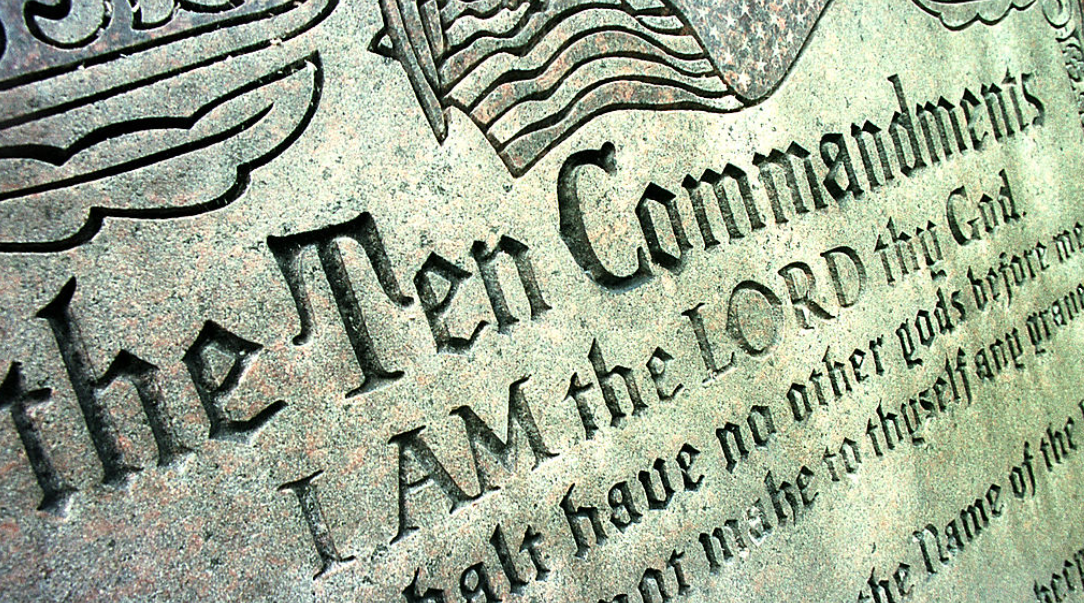
A bill to place the Ten Commandments in Hoosier public schools cleared its first legislative hurdle Tuesday — but in a scaled-back form that leaves decisions over whether to display the religious text up to local schools.
House Bill 1086, authored by Rep. Michelle Davis, R-Whiteland, advanced 8-3 from the House Education Committee in a party-line vote after members amended out earlier language that would have explicitly required display of the Ten Commandments in classrooms and school libraries.
The measure now heads to the House floor, with a full chamber vote due by Monday.
The latest draft of the legislation makes display optional and instead adds the Ten Commandments to Indiana’s list of “protected writings” in education law. The designation governs how certain historical documents may be maintained, referenced and displayed in public schools.
Supporters described the bill as a way to acknowledge what they view as the Ten Commandments’ historical significance and called it an “important” teaching tool for young people. Opponents, though, warned it blurs constitutional boundaries between church and state.
The debate comes amid ongoing national scrutiny of efforts to place the Ten Commandments in public schools. Courts are currently weighing challenges to a Louisiana law requiring classroom displays, while Texas is defending a similar statute. Lawmakers in other states, including South Carolina and Ohio, have also introduced related proposals.
And earlier this month, Hoosier officials sought to lift a decades-old ban on a Ten Commandments monument at the Indiana Statehouse, asking a judge to dissolve a long-standing injunction that has blocked the monument’s installation since the 1980s.
“Without the basis of the Ten Commandments, we would not have a Declaration of Independence. We would not have a U.S. Constitution. It is the basis on which those foundational documents were built. … It is the basis of our legal system,” said Timothy Huggins, a Greenwood resident who testified in favor of the bill.
“Every law that you pass has its foundation somewhere in one of those Ten Commandments,” he continued. “We need to have that up. We need to have it posted. We need to have the opportunity to speak in our public schools about the foundation of our society, the foundation of our legal system, the foundation of moral right and wrong.”
‘A no brainer’
Indiana law already identifies 15 “protected writings,” including the U.S. Constitution, the Declaration of Independence, the Federalist Papers and Frederick Douglass’ 1852 speech “What to the Slave Is the Fourth of July?”
Under existing statute, schools must keep copies of those protected writings in their libraries and can’t censor any content “based on religious references.” Students must also be allowed to reference any of the protected texts in coursework without penalty.
House Bill 1086 would add the Ten Commandments to that list.
Schools would also be required to maintain a copy of the Ten Commandments in their library collections, alongside other protected writings, but the document would not have to be posted on classroom walls unless local officials choose to do so.
“It does not have to be posted, doesn’t have to be hanging up,” Davis said. “It just has to be maintained.”
The bill would not permit a principal or teacher to “read the Ten Commandments aloud when students are present,” however. That stipulation does not apply to the other protected writings in state law.
Davis and other supporters argued that adding the Ten Commandments to the protected writings list recognizes its “historical role” rather than imposing religious instruction.
“Some of them can be,” Davis said when asked whether the existing protected writings are religious.
Supporters who testified described the Ten Commandments as foundational to Western law and moral instruction.
Ryan McCann, executive director of the Indiana Family Institute, called the principles in the text “basic underpinnings of morality within Western civilization.”
“We really think this is a no brainer to encourage this kind of morality within public schools,” McCann said.
“And it’s really not new in American history,” he added, citing notable public displays of the Ten Commandments.
“You go to the United States Supreme Court in Washington, D.C. — Ten Commandments. You go to Library of Congress — there’s the Ten Commandments. You go to other other places throughout the nation, it’s the Ten Commandments,” McCann said. “They’re really the basis of morality and understanding that we have in our country … and how to live together as citizens.”
Bre’Anna Donaldson with the Indiana School Boards Association said the amendment resolved earlier concerns from the group, which is now neutral on the bill.
“All our concerns that we had with the original bill,” she said, “we no longer have.”
Critics warn of church-state concerns
But opponents argued the bill still risks violating the constitutional separation of church and state, even with the mandate removed.
Rep. Ed DeLaney, D-Indianapolis, said he remained concerned that the updated draft simply shifts pressure onto individual educators.
“I frankly think this amendment does nothing but cause confusion and try to distract us from the real point,” he said.
Zachary Parrish, the co-founder of Secular Education Association, noted that courts have repeatedly rejected efforts to place the Ten Commandments in public school classrooms.
“The debate around the Ten Commandments and public schools has been long settled,” Parrish said, citing U.S. Supreme Court precedent. “The intent of this bill is very clear.”
Representatives of multiple faith groups — including Jewish, Muslim and Christian leaders — testified that the bill could alienate students of minority faiths and oversimplify a religious text that requires deeper interpretation.
“As someone who teaches about the Ten Commandments to students every year, I can’t help but wonder, which Ten Commandments is the bill asking schools to display?” asked Tim McNinch, an Old Testament professor at the Indianapolis-based Christian Theological Seminary. “Their meaning needs to be interpreted.”
Rabbi Aaron Spiegel of the Greater Indianapolis Multifaith Alliance said the measure risks “religious favoritism.”
“Public schools are not appropriate places to address these critical questions,” Spiegel said. “America is strengthened by pluralism.”
American Civil Liberties Union of Indiana Senior Policy Analyst Samantha Bresnahan further warned that allowing teachers to post the Ten Commandments could still be perceived as government endorsement of religion.
“Posting the Ten Commandments in the classroom will do” precisely what the Establishment Clause forbids, she said.
“All students, regardless of their faith, should feel safe and welcome in our public schools. Displaying the Ten Commandments would expose students, daily, to a government-presented religious message which can be perceived as coercive to impressionable students,” Bresnahan told the House committee. “Religious freedom is best protected when belief is chosen freely — not directed by the government.”