By Tom Davies
Indiana Capital Chronicle
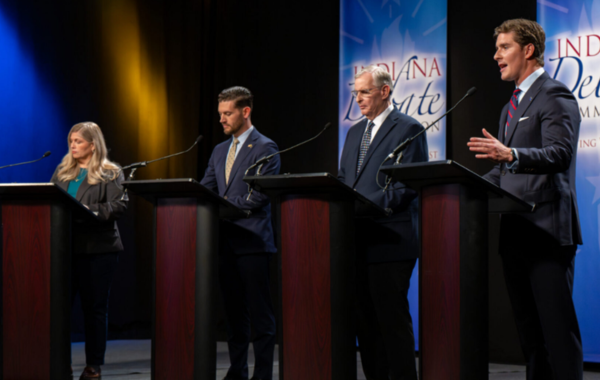
Republican Max Engling leaned into blocking noncitizen voting as a top priority as he and the other three Indiana secretary of state candidates debated Wednesday night.
Engling maintained that he was the only candidate firm on that issue — arguments that Democrat Beau Bayh called “ridiculous” and Lincoln Party candidate Greg Ballard labeled “ludicrous.” Libertarian Lauri Shillings described Engling’s push for tighter voter rules as unnecessary.
Bayh kept up his persistent push for an independent audit of what he calls corrupt spending by current Republican Secretary of State Diego Morales, whom Engling defeated for the GOP nomination.
Ballard used the televised matchup, sponsored by the nonprofit Indiana Debate Commission, to assert that an overhaul of the state’s Election Commission and Recount Commission was needed to remove political bias.
Here are key topics that emerged in the hour-long debate:
Quarrel over noncitizen voting
The sharpest exchanges of the night came over Engling’s arguments that other candidates weren’t as dedicated to blocking noncitizens from voting.
“They all said it was unduly burdensome to verify if you’re a U.S. citizen to be voting in our elections. That is a very big problem and they all said it,” Engling said. “The question was: Do we need to ensure that it’s only U.S. citizens voting in our elections? The answer is an absolute ‘yes,’ and I’m the only candidate that has said that and put that straightforward.”
Republicans have won every election for the office since 1994.
Ballard, who was a two-term Republican mayor of Indianapolis, quickly retorted Engling’s statement.
“That’s a ludicrous assertion. We all think that,” Ballard said. “That’s ludicrous.”
Other candidates pointed out that voting by noncitizens is already illegal.
Bayh said during the debate that he supported Indiana’s current voter ID law and told reporters afterward that “our elections are safe and secure in our state.”
“Max is making this up because he wants to stoke fear and divide people and dissuade you from participating,” Bayh said. “People should have faith in our elections. We have 92 county clerks from both major political parties who do a fantastic job on a bipartisan basis, making sure these things run smoothly.”
Engling, who most recently was a top staffer to Republican U.S. Sen. Jim Banks, said he would advocate for Indiana to adopt driver licenses with different backgrounds for noncitizens as a further safeguard against them casting election ballots.
Shillings said after the debate that Engling was “looking for a problem that doesn’t exist.”
“What he’s trying to do is bring the Republican SAVE Act and shove it down into our realm, and I think it’s unnecessary entirely,” she said. “We already have checks and balances in place to prove citizenship when you register to vote and our clerks do a great job of catching that.”
Bayh aims to keep Morales an issue
Bayh never mentioned Morales’ name during the debate, but repeatedly brought up the spending controversies from his time in office.
“The current secretary of state has spent $92,000 of your taxpayer money on a luxury SUV for himself,” Bayh said. “He’s hired members of his family, six-figure positions. He’s taking trips all over the world and won’t tell us who’s paying or the purpose of the travel. He’s given out millions of dollars in no-bid state contracts to his largest campaign donors. That’s unacceptable.”
Bayh said he would immediately start a forensic audit of Morales’ spending and pledge to not give any contracts to campaign contributors.
Engling countered that he would support a review of the secretary of state’s office by the state inspector general.
“I am the only candidate that has actually done something about the issues that we’ve seen in the office,” Engling said. “I ran at the (Republican) convention and replaced the current secretary of state. I am the Republican candidate in this race, and I’m pressing forth to win, to bring new processes, to bring new procedures into this office.”
After the debate, Bayh said an inspector general review was insufficient and that Engling “wants to kick this can down the road, pretend like this corruption never happened.”
“The inspector general was appointed two years ago by the Republican governor, who’s Max Engling’s biggest supporter,” Bayh said. “For two years, the inspector general has looked at the purchase of luxury SUVs in this office, has looked at no-bid contracts to large donors and has
Voting change priorities
looked at unexplained world travel and hiring relatives, and not taken action.”
Bayh highlighted his support for ending straight-ticket voting and allowing citizen-led ballot initiatives — both issues that Democrats have unsuccessfully pushed for several years in the Republican-dominated Legislature.
“We’re one of only six states in the country which has a straight-ticket voting system,” Bayh said. “What this means is that the first page on your ballot won’t have a list of names or offices on it. It’ll have political parties — red team, blue team. That reinforces some of the worst instincts of tribal politics.”
Engling said after the debate that he believed voters should have the option of casting a straight-ticket ballot.
He derided citizen ballot initiatives as “a way for folks that cannot work an issue through the Statehouse to try and evade the Statehouse.”
“Very often what we’ve seen is that ballot initiatives are sponsored by folks with millions and millions of dollars to try and do something that the state didn’t want to do through their elected legislators,” Engling said.
Ballard pressed his desire to revamp the state’s Recount Commission and Election Commission, both of which are now controlled by appointed Republicans and Democrats.
Ballard faulted the setup for the lack of investigation into complaints about possible improper campaign donations.
“Because there’s two Republicans and two Democrats on that Election Commission, they’re not meeting either because they don’t want to meet,” he said. “Those duties should be handed off to administrative law judges.”
About the office
The secretary of state is an administrative official who broadly oversees statewide policies for elections, which are run by county officials. The secretary, by law, is chair of the Indiana Recount Commission.
Other office responsibilities include the registration of businesses and nonprofit organizations, regulation of the securities industry, commissioning of notaries public and the licensing of motor vehicle dealerships.