By Mackenzi Klemann
Indiana Capital Chronicle
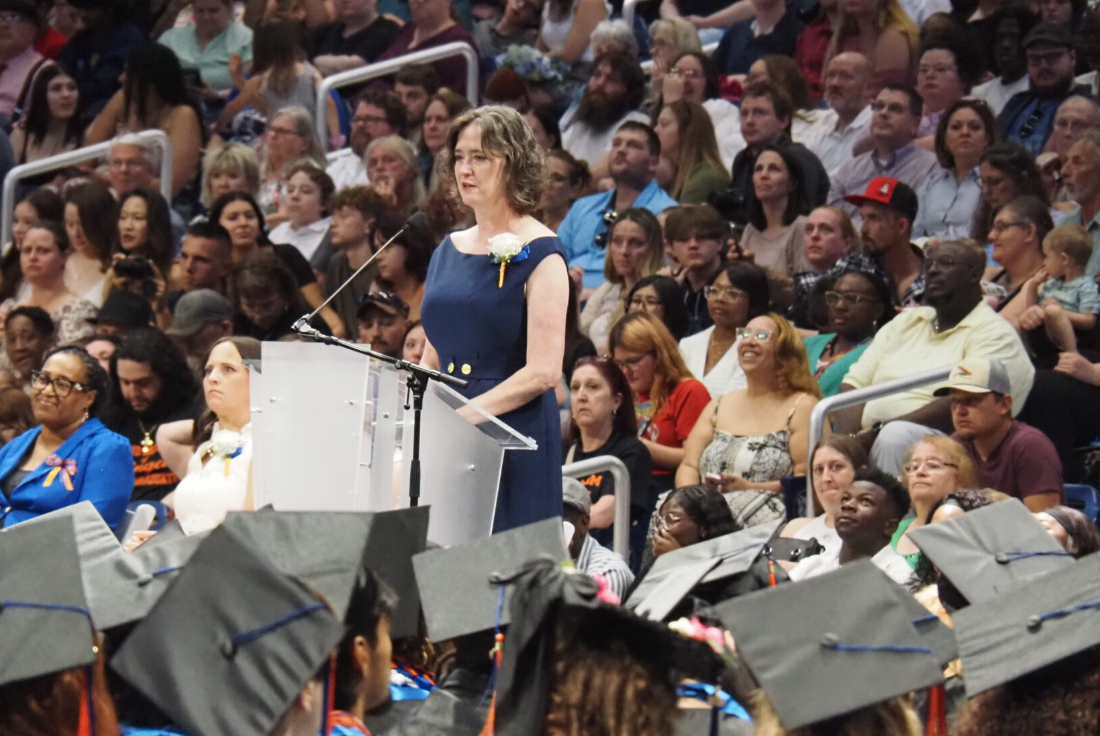
Sabanna Yenna situates herself into a seat in the crowded Hinkle Fieldhouse, surrounded by 900 of her virtual classmates gathered in anticipation of Indiana Digital Learning School’s inaugural in-person commencement ceremony.
Yenna enrolled in the virtual school, now in its 10th year, her freshman year to escape bullies in her home North White School Corp. in White County.
Now that she could relax in class, she soon joined the FFA and became president of the school’s National Technical Honor Society chapter.
“I met teachers that were like family members to me, and they took me in like siblings and daughters,” she said. “I felt wanted — not being judged by who I was.”
Yenna is one of nearly 29,000 Hoosiers who attended virtual K-12 schools in 2025, according to an Indiana Capital Chronicle review of enrollment data through the state’s Graduates Prepared to Succeed portal.
The practice continues to expand despite ongoing legislative debate over state tuition support, financial and academic oversight.
Supporters say virtual schools are an outlet for students who fail to thrive in traditional school settings, allowing them to recover credits and work at their own pace until they can return to in-person schooling.
Critics see the continued expansion of virtual schooling as evidence of a breakdown in the state’s school funding model, with more oversight needed.
The growth is led by an unexpected partner: traditional public schools.
Lucrative arrangements
Public schools can enter into cooperative agreements with third-party virtual school providers to capture a portion of state tuition dollars directed to those students, in exchange for full accountability for their academic performance.
The arrangements can be lucrative, presenting an opportunity for financially challenged districts to offset declining student enrollment without raising property taxes.
“I don’t like the idea that school districts pick these systems up for financial reasons,” said Rep. Ed DeLaney, an Indianapolis Democrat. “That tells you there’s a core problem in financing our public schools.”
The arrangements are not without consequence: Lawmakers approved an amendment to the budget bill last year to close the Union School Corporation, citing poor academic performance at the rural district, where virtual students now outnumber traditional students by a ratio of 25 to 1.
At least part of the district’s poor academic performance appears to be linked to virtual students, as a higher proportion of Union Elementary third graders met proficiency standards on the IREAD exam than their virtual peers at Indiana Digital Elementary School.
Union filed a lawsuit to stop the closure, set for trial in November.
But Indiana Digital Learning Schools, which have partnered with Union since 2016, won’t have to close if a jury upholds the law.
The virtual school, run by national for-profit network Stride-K12, signed new cooperative agreements with Beech Grove and MSD of Warren County Schools to keep Indiana Digital Learning Schools in operation — with enrollment to be divided between the three districts while the lawsuit proceeds.
Stride oversees other schools in Indiana, including a private college preparatory academy for Marian University and a public, tuition-free school similar to Indiana Digital through Clarksville Community School Corporation.
Ralph Shrader, superintendent of MSD of Warren County schools, said he initiated the conversation to partner with Stride after failed attempts at using other online platforms.
“We felt that we were missing out on servicing our students in our community in a way that allowed us to reach all students,” he said. “We were missing a population.”
The rural district is 13 miles from the Illinois border, with a student population of 1,332.
How oversight changed
The relationship between public schools and virtual school providers has evolved from the early days of online learning.
Initially, school districts could authorize or monitor virtual charters.
Lawmakers revised this setup after a state audit found two virtual charter schools authorized by Daleville Community Schools had collected $68 million through inflated enrollment or “ghost” students.
Now, public schools cannot authorize or monitor a virtual charter, but can still enter into agreements with online school providers — one of several reforms to rein in a troubled industry.
In practice, this means operational responsibility, salaries and academic performance of virtual schools are no longer segregated from public school partners, said Rep. Behning, an Indianapolis Republican who chairs the House Education Committee.
“Everything flows through the school district,” he said.
To monitor enrollment, the State Board of Accounts reviews attendance records for a sample of students. The Indiana Department of Education then recovers any tuition support if a student is found to not be enrolled.
Additional oversight of these arrangements is expected soon: The State Board of Education is drafting financial reporting and oversight rules for school districts that enter into or renew contracts with outside virtual learning providers, due by the end of the year.
Elizabeth Sliger, executive director of the Indiana Digital Learning Schools and its sister Indiana Digital Alternative School, said she welcomes transparency and accountability.
“I knew after Daleville I needed to prove what an accountable virtual school looks like,” she said. The schools require proof of Indiana residency for each child, and file annual financial reports to district partners.
Forthcoming rules are “just codifying what we’re already doing,” Sliger said. “We’re not afraid of accountability. What we need is transparency” of what compliant reporting means to lawmakers.
Virtual schools receive 85% of the funding that brick-and-mortar schools get per student, and there have been efforts in recent years for equal funding.
Are reforms working?
Reforms appear to be working to Behning, whose granddaughter attended Indiana Gateway Digital Academy for two years.
“She had her own counselor,” he said. “She was on student council. They had afterschool activities. She had tutors available if she felt like she was getting behind. She had one-on-one support if she needed.”
“What happened in the pandemic was a crisis mode,” Behning said — nothing like the organized virtual schools of today. Still, he said student success in either virtual or traditional schools is dependent upon parental involvement.
The potential for inadequate parental involvement concerns DeLaney, who likened virtual schooling to homeschool.
“You’re dependent upon the parental supervision,” he said. “Are they making sure their kid is there when that’s necessary, or when it’s asynchronous, are they putting their kid on adequate time? Are they giving him an environment and assisting the kid or not?”
Asynchronous means allowing students to complete work on their own time and schedule.
Kylene Varner, a homeschooling advocate for the Indiana Association of Home Educators, said even the most engaged virtual school parents typically aren’t supervising their child’s instruction for six hours a day, unlike the hands-on approach common to homeschooling.
“They might be popping in,” she said, adding “That is what some families need and want, and that is completely fine. That’s their choice. But when it comes to a homeschool family, we make all the decisions.”
Expanding virtual schooling beyond the small population of students who can’t acclimate to in-person schools for emotional or physical reasons still troubles DeLaney.
“If we were serious, if we thought this were a useful program, we’d have the state sponsor a program that was well-managed and well thought out and go from there,” he said. “But we’re not doing that.”
A day at Indiana Digital Learning Schools
Indiana Digital Learning School launched in 2016. At the time, only 400 students enrolled. Enrollment surpassed 9,000 last school year, according to a spokesperson. There are over one million public school students statewide.
Indiana Digital Learning Schools are tuition-free, available to any Hoosier from kindergarten through 12th grade, regardless of where they live in the state.
The alternative is a popular choice for students who fail to thrive in traditional classrooms, encompassing everyone from student athletes and teen parents who need flexible class schedules to advanced or credit deficient students who want to work at their own pace.
“I like to say that we’re a dichotomy of diversity,” Sliger said.
The school loans computers to families who don’t have their own.
Elementary students meet daily in online reading and math groups each day, reading aloud on Zoom-style platforms for their peers and teachers.
Parents are expected to act as a “learning coach,” recording attendance and reviewing student work as students gain independence.
High school students attend individual and group sessions each week, with attendance monitored Monday through Friday.
Students are expected to dedicate at least six hours per class a week, and can enroll in dual-credit classes, career technical programs, internships, apprenticeships and student clubs outside of class.
Sliger said it’s similar to traditional schooling, “but we’re just finding creative ways to use technology to create those tricks teachers have known for 50 years.”
A majority of Indiana Digital students enter two to three years behind grade level, she said.
Those students typically return to in-person schooling within two years, which means their gains don’t always appear on accountability reports — a reality Sliger hopes the State Board of Education will one day resolve.
“By the time we get them close to proficiency, they may then return (to in-person schooling,” Sliger said. “They come to us three years behind. We’re graded at what we do in 162 days without the ability to show, to reach the points that proficient students get.”
Shannon Wilson came from the public schools to Indiana Digital Alternative School as a special education teacher three years ago.
She maintains a regular schedule for live classes, but makes time for students to pop in for one-on-one video sessions, calls or text messages as needed.
Where she once saw students unable to cope with the chaos of the classroom, she now saw students at ease as they worked from the comfort of their home.
“They can really be authentically themselves,” she said, “and that makes such a difference.”