
WASHINGTON (AP) — In a lightning military strike, the U.S. captured Venezuelan President Nicolás Maduro and his wife, Cilia Flores, and spirited them out of the country to face justice in the United States.
Now President Donald Trump says the U.S. is “going to run” Venezuela until a transition of power can take place, but it’s not clear what that will mean on the ground in the South American country.
The overnight operation left Venezuela reeling, with its leadership uncertain and details of casualties and the impact on its military still to emerge. Much is still unknown about how the U.S. ouster of Maduro will ricochet across the country and the region.
Here’s what we know — and what we don’t.
Explosions rang out and low-flying aircraft swept through Venezuela’s capital, Caracas, early Saturday. At least seven blasts were heard in an attack that lasted less than 30 minutes. The targets appeared to include military infrastructure.
Venezuelan ruling party leader Nahum Fernández said Maduro and Flores were captured at their home within the Ft. Tiuna military installation outside Caracas.
Venezuelan officials said people had been killed, but the scale of casualties was unclear.
The attack followed months of escalating pressure by the Trump administration, which has built up naval forces in the waters off South America and, since early Septembe,r has carried out deadly strikes on alleged drug-smuggling boats in the eastern Pacific and Caribbean. Late last month, the CIA carried out a drone strike at a docking area alleged to have been used by drug cartels.
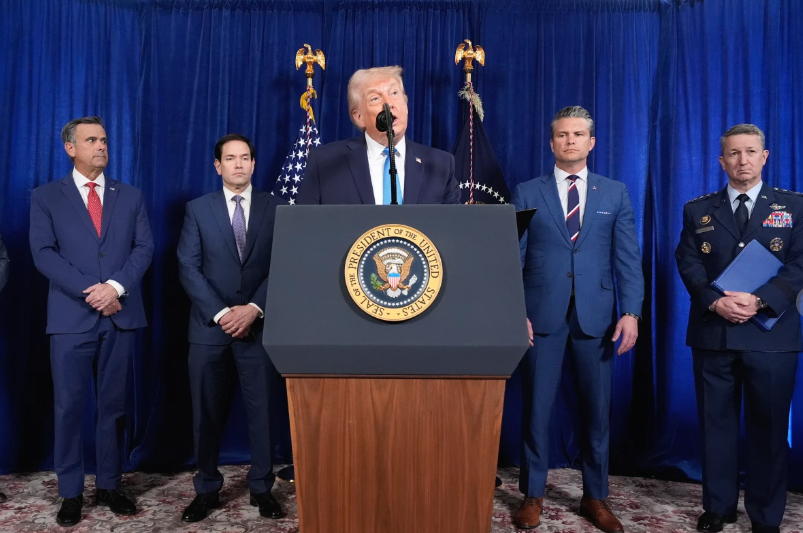
Trump said during a news conference Saturday the U.S. would run the country and gestured to officials arrayed behind him, including Secretary of State Marco Rubio, Defense Secretary Pete Hegseth and Dan Caine, chairman of the Joint Chiefs of Staff, and said they’d be the ones doing it “for a period of time.”
Trump claimed the American presence was already in place, although across Venezuela’s capital, there were no signs that the U.S. had taken control of the government or military forces.
Trump claimed that Venezuelan Vice President Delcy Rodríguez had been sworn in as president shortly before he spoke to reporters and added she had spoken with Rubio.
“She is essentially willing to do what we think is necessary to make Venezuela great again. Very simple,” Trump said.
But during a televised address after Trump’s news conference, Rodriguez made no mention of talking to Rubio, of taking over the presidency or of cooperating with the U.S. State television has not shown a swearing-in ceremony and during her address, a ticker at the bottom of the screen identified her as the vice president.
Instead, she demanded the U.S. free Maduro, called him the country’s rightful leader and said what was happening to Venezuela “is an atrocity that violates international law.”
Rodriguez left open the door for dialogue with the U.S., while seeking to calm ruling party supporters.
“Here, we have a government with clarity, and I repeat and repeat again … we are willing to have respectful relations,” she said, referring to the Trump administration. “It is the only thing we will accept for a type of relationship after having attacked (Venezuela).”
Armed individuals and uniformed members of a civilian militia took to the streets of a Caracas neighborhood long considered a stronghold of the ruling party. But in other areas of the city, the streets remained empty hours after the attack. Parts of the city remained without power, but vehicles moved freely.
Trump offered no details on what U.S. leadership in Venezuela would mean or specify whether it would involve more military involvement.
The State Department did not immediately respond to questions about how the U.S. would run Venezuela, what authority it would use to administer it or whether it would involve any American personnel — either civilian or military — on the ground in Caracas or other areas of Venezuela.
Trump mentioned the country’s oil infrastructure repeatedly during the news conference. He suggested there would be a substantial U.S. role in Venezuela’s oil industry, saying that U.S. oil companies would go in and fix the broken infrastructure.
And Trump said the U.S. would use revenues from oil sales to pay for running the country.
“We’re going to get reimbursed for everything that we spend,” he said.