By David Slone
Times-Union
WARSAW — Since it opened in 1976, Lutheran Kosciusko Hospital (LKH) — formerly Kosciusko Community Hospital (KCH) — has changed in many ways.
Tuesday evening, LKH marked its 50th anniversary with a celebratory open house. Giving remarks about the roots of the hospital, its present and its future was Chad Towner, LKH chief executive officer.
“We are celebrating the past, recognizing the current and also really looking for inspiration in the future,” he said, noting they weren’t just celebrating a building. “We’re actually celebrating a promise that we made to this community 50 years ago. And if you think about it, where were you on June 7, 1976? Some of you were around, some of you weren’t. On June 7, 1976, that was the first day that we opened our doors to care for a patient in this building, and things have changed so much over the years.”
A ribbon-cutting for the hospital took place on May 24, 1976.
“So when this hospital opened, and then served that first patient on June 7, it was so we could provide incredible care close to home. People didn’t have to travel to Fort Wayne, travel to South Bend, travel to Indianapolis or even farther. They were able to get incredible care here,” Towner stated.
Looking back at the history of the hospital and its campus, he said it was truly built by the community.
“Some of you may not realize, it was planned originally as a 113-bed hospital on this 25-acre piece of land that was donated by eight physicians in the community. They had a vision,” he said.
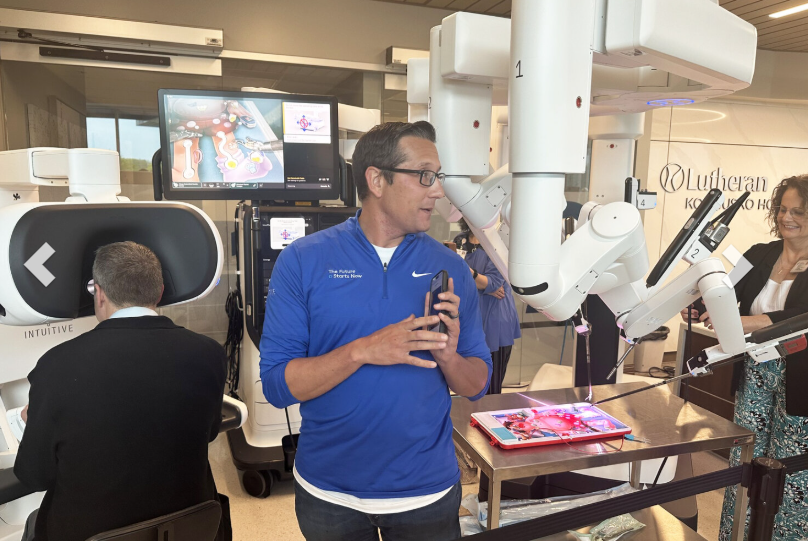
The hospital was a $6.5 million build by the time it was completed in 1976. A Da Vinci 5 Robot, used for surgery at LKH and that was on display Tuesday for the open house, cost $2.5 million.
“So when we dedicated it in May of 1976, it was not just a single small event. Put this into perspective: we had over 10,000 people here for the ribbon-cutting; 10,000 people showed up. Governor Otis Bowen cut the ribbon, and what’s really remarkable about that is what he was doing at the time as a physician, but then eventually he later served as U.S. secretary of health and human services under President Reagan,” Towner said.
At that time, the U.S. Census for Warsaw put its population at about 7,500 residents. The county was about 48,000. Today, there are about 81,000 residents in the county and 16,000 in the city.
The hospital has grown with the community, Towner said. It invested $30 million in improvements over the last few years.
“So when you think about, we opened in 1976, medicine looked very different. At that time, CT scanning was brand new. MRI was not even used at the time because the first MRI (exam) was in 1977. No coronary stents. No statins. No tPA for strokes. There was no electronic medical record. No patient portals. No online scheduling. No robotic surgery…. All these things that now are expected as our service in what we do,” he stated, noting how remarkable it is of what’s been accomplished over the last 50 years.
Towner said the hospital’s mission in 1976 is the same as it is now.
“And the investments we’ve made with people, equipment, processes, we’re doing life-saving care in this building every single day,” he said. “So when you think about 1976, KCH, now we’re Lutheran Kosciusko Hospital. It was four years ago that we made the decision to rebrand under Lutheran Kosciusko to tie in tighter with our Lutheran Health Network partners. It was at that time, that day, we also announced the $30 million investment that we’re sitting within today. So we’re honoring legacy, but also looking at the future.”
Towner, who’s been the LKH CEO for almost two years, then presented some numbers for people attending the 50th anniversary celebration to think about.
“In that two-year window of time, as far as patient encounters, in the hospital, the clinic, the ambulance service, 559,000 patient encounters in the last two years – 559,000 times, someone came to us for help. It may have been the worst day of their life, the scariest day of their life or just routine physicals and checking to make sure everything’s on track,” he said.
Within that 559,000 over the last two years, there were 31,000 emergency visits, he said. There were about 9,000 surgeries and 800 births.
“Over the last two years, from an economic impact standpoint, $278 million of economic impact in this community. Let that register,” Towner said.
That $278 million over the last two years includes $43 million worth of charity care at LKH, where people didn’t have insurance or couldn’t cover their co-pay and deductible.
LKH is a for-profit hospital and pays taxes, he said.
“The tax bill that we paid for local and state taxes over the last two years: $18 million. And within that, a big chunk of that, is paying into the Medicaid fund for the state of Indiana, but we also have property taxes supporting the schools, supporting municipalities, police, fire and infrastructure. So $18 million in taxes, $43 million in charity, total of $278 million local economic. What’s the rest of the impact? Salaries. Salaries for the people that work here, that live here, that spend their money in the community.”
Towner said the more LKH grows, the stronger it is and the more taxes it pays for schools and everything else.
“So we need you, just like you need us, and that’s another reason for today. The hospital is not only a hospital and healthcare infrastructure, we are an economic engine and a safety net for the community. We support employers, we support families, we support public safety, we support the schools, we help recruit new business. We help young families decide whether they can build a life here,” he said.
He said they’re providing a level of care now that couldn’t have been imagined in 1976, which made him wonder what healthcare will look like in another 50 years.
The Da Vinci Robot 5 is new to LKH, having bought it in 2025. It’s new technology, but the manufacturer of it, Intuitive Surgical Inc., is already looking at their next generation of it. With the Da Vinci 5, a hysterectomy can be performed with an incision that leaves a scar less than 3 inches. With some procedures, the incision is less than the size of a dime. The tissue damage is less and people get back to their lives quicker. Over 3,000 surgeries have been done by doctors with the robot.
“It’s incredible how fast that technology is going. But, emergency care, what’s happening there. Your urgent care, orthopedics, surgical services, the Birthing Center – it’s incredible what we’re doing right here,” Towner stated.
Since LKH started the Cardiac Cath Lab several years ago, he said they’ve saved 1,400 patients’ lives. “In that case, minutes count.”
The Cancer Center has been open for 20 years, saving lives, he said before listing the various centers and departments of the hospital.
He also announced last week that LeapFrog – a national organization that looks at every hospital in the country – rated LKH an “A,” up from a “B” and “C” over the last few years.
When KCH was sold in 1999, $63 million spun into the creation of the K21 Health Foundation, Towner pointed out. “And think about the impact K21 has had. It’s one of the best nonprofit support systems in the country. It’s incredible what we’re doing and it started with the sale of this property,” he said.
As part of the 50th celebration, Towner said they had an idea of creating a time capsule. Warsaw Cut Glass created the time capsule.
“Our intent is on June 7, on the 50th anniversary, to seal it. Between now and then, we’re gathering stories,” he said.
People were encouraged to scan a QR Code, which takes them to a form where they can share their story and experience with LKH.
“Some of you were born here. Some of you had the best day of your life, some of you also had to say goodbye to some loved ones. We want to hear the story and we want to capture that and insert it into the time capsule. On the 7th we’re going to seal it and then it’s going to be a permanent fixture somewhere in this room (lobby),” Towner explained. “And that’s our gift to the community.”
The message he hopes will be in the time capsule is that in 1976, the community believed that healthcare close to home was worth building, and they built it. “In 2026, the community still believes healthcare close to home is worth protecting, worth strengthening, choosing and investing in.”