
By Casey Smith
Indiana Capital Chronicle
Gov. Mike Braun on Monday called a special session to take up congressional redistricting, a politically charged move that follows months of mounting pressure from national Republicans to redraw Indiana’s map ahead of the 2026 midterm elections.
Braun’s order says the session will begin Monday, Nov. 3 and will focus primarily on revising the state’s congressional boundaries — lines that were last redrawn in 2021 following the U.S. Census.
Braun’s office said lawmakers will use the special session to “consider altering the boundaries of Indiana’s congressional districts,” but also to “consider resolving an important issue regarding federal and state tax compliance that must be addressed.”
“I am calling a special legislative session to protect Hoosiers from efforts in other states that seek to diminish their voice in Washington and ensure their representation in Congress is fair,” the governor said in a Monday morning statement. “I am also asking the legislature to conform Indiana’s tax code with new federal tax provisions to ensure stability and certainty for taxpayers and tax preparers for 2026 filings.”
The news release from the governor’s office noted that Indiana uses federal tax law as the starting point for the Indiana tax return, and the recent changes to federal tax law in the One Big Beautiful Bill Act include provisions “that impact Indiana state tax filings.”
Addressing that “discrepancy” through a special session “will provide taxpayers, accountants and businesses the confidence and clarity ahead of filing season, avoid amended returns and filing delays, and continue the Indiana Department of Revenue’s strong record of fiscal management,” according to Braun’s office.
The state’s most recent special session in 2022 — which lasted two weeks and centered on abortion-related legislations — cost taxpayers about $240,000 in per-diem and travel expenses.
Legislative leaders don’t have to convene the exact day that Braun suggested. By law, the only rule is it can’t last for more than 30 session days or 40 calendar days. That clock will begin Nov 3.
In 2022, then-Gov. Eric Holcomb’s order began the session on July 6 but lawmakers didn’t convene until July 25, and it ended Aug. 5.
The announcement comes after weeks of speculation in the Statehouse, fueled by a series of meetings between Hoosier GOP leaders and top figures in President Donald Trump’s orbit, including Vice President JD Vance. Trump spoke with Indiana Senate Republicans by phone on Oct. 17.
Discussions have centered on ways to strengthen the party’s position in the U.S. House — where Republicans hold a narrow majority — by encouraging states with GOP strongholds to redraw districts before 2026.
During the leadup, House Speaker Todd Huston and Senate President Pro Tem Rodric Bray have refuse to publicly say where they stand.
It’s unclear how long the special session will last. Lawmakers could suspend rules to pass a map in just a day or two, but it’s unlikely there are enough votes to do that. A bill must be heard three times in each chamber, meaning a likely minimum of six days.
Legislative leaders are expected to outline their next steps in the coming days.
The last time Indiana redrew its congressional lines, the process stretched over several months and included statewide public hearings. This time, lawmakers will be under greater pressure to move quickly.
Candidate filing for the 2026 primary opens Jan. 7, leaving a narrow window for debate, map approval and potential legal challenges.
The next regularly scheduled legislative session will kick off in January.
Special session just one week away
Senate Democratic Leader Shelli Yoder called Braun’s decision to convene a special session “a political stunt at the expense of every working Hoosier,” accusing state Republicans of bowing to national pressure.
“This is not democracy. This is desperation,” Yoder, of Bloomington, said in a statement issued on behalf of the Senate Democrat Caucus.
She said the push to redraw maps mid-decade “proves” Democrats’ warnings of a broader national effort to erode democratic norms.
“There is no new census, no court order and no support from the public,” Yoder said. “There is only political greed and fear — fear of voters, fear of accountability, fear of losing power the right way, at the ballot box.”
Braun has maintained that his goal is to “let the Legislature lead,” emphasizing that he wants the process to unfold through normal legislative channels rather than by executive dictate.
The Republican governor had previously said he would wait to call lawmakers back until they signaled readiness, telling reporters in August, “You’re going to hear individual representatives and senators speak up … that process will take a while to play out.”
But Braun also warned that “if we try to drag our feet as a state on it, probably, we’ll have consequences of not working with the Trump administration as tightly as we should.”
Indiana’s GOP legislative leaders have met at least three times with Vance in recent weeks. Bray described the latest conversation as “productive,” though he stopped short of confirming whether Senate Republicans were fully united behind an early redraw.
Before Braun’s decision, opposition had been building among both Democrats and some Republicans.
Sen. Greg Walker, R-Columbus, said in August that there is “no justification” for revisiting maps drawn less than four years ago, arguing that redistricting should occur only after the decennial census. And Sen. Sue Glick, R-LaGrange, separately told the Indiana Capital Chronicle earlier this month that most lawmakers she’s spoken with aren’t eager to reopen the maps.
Democrats have likewise accused the governor and GOP leaders of orchestrating a “partisan power grab” meant to benefit Trump-aligned candidates. Senate Minority Leader Shelli Yoder of Bloomington said following Vance’s October visit to Indiana that Republicans “don’t have the votes, currently” to pass new maps without dissent within their own ranks.
That skepticism appears to mirror public sentiment.
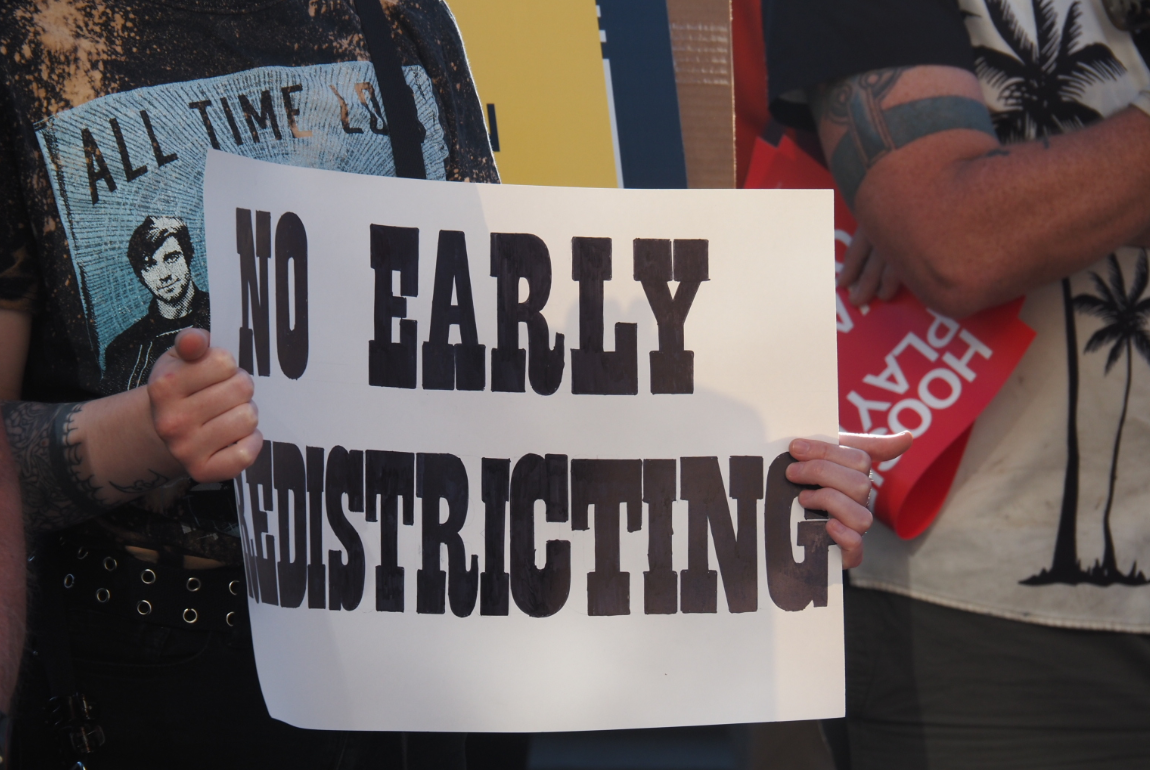
Multiple polls — including one released in August and one earlier this month — have found that the majority of Hoosiers oppose early redistricting.
One statewide survey found that a majority of Hoosiers — about 53% — oppose early redistricting, compared to just 34% who support it. Another survey showed waning trust in both parties, with growing numbers of voters saying they feel disconnected from state political leadership.
But in recent days, a flurry of Senate Republicans have announced their support.
The Capital Chronicle has been tracking public statements on the proposal. As of Monday, 11 Senate Republicans have come out in support, while five are against. The rest of the 40-member caucus is undecided or haven’t commented publicly.