
By Chris Schumerth
Sports Capital Journalism Program
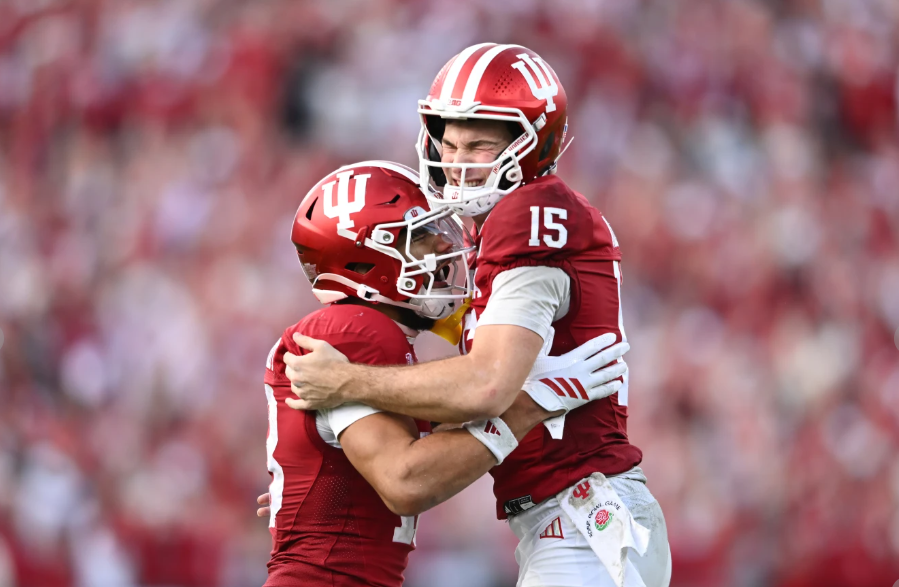
PASADENA, Calif. — The rain was gone, the clouds had given way to sunshine, and in the first minute of the fourth quarter of an unforgettable 112th Rose Bowl, John Mellencamp’s “Hurts So Good” boomed throughout the grand old stadium.
It was the perfect song for the most remarkable party in the no longer agonizing history of Indiana University football.
For one historic day the suffering had ended, the song a symbol of the 38-3 throttling the Hoosiers put on Alabama in the school’s first Rose Bowl victory.
“We were able to kind of make the plays when we needed to and take it over in the second half,” Indiana coach Curt Cignetti said. “And you know it’s a great win for our football program. I’m proud of our players, our coaches, and everyone. Again, a big win against a team that’s got great tradition like that and history, a lot of good players, and great head football coach.”
A hundred years to the day that the Crimson Tide beat Washington, 20-19, in their first Rose Bowl appearance, the game that validated football in Alabama and the south, the 35-point defeat was the worst post-season defeat in program history, surpassing a 38-6 loss to Nebraska in the 1972 Orange Bowl. Alabama’s previous worst loss in the College Football Playoff was a 44-16 loss to Clemson in the 2019 championship game. The 35-point margin tied for the sixth-highest in Rose Bowl history.
Indiana (14-0) advanced to a semifinal of the College Football Playoff against Oregon in the Peach Bowl at Atlanta next Friday night. Indiana became the 10th school to win 14 games since 1937 and became the tenth No. 1-ranked team to win the Rose Bowl.
Alabama (11-4), which has won a record 42 bowl games in a record 73 appearances, tied its second-lowest scoring total in a bowl game. Alabama tied Texas 3-3 in the 1960 Bluebonnet Bowl and was shut out by Penn State in the 1959 Liberty Bowl and California in the 1938 Rose Bowl.
Fernando Mendoza became the eighth Heisman Trophy winner to lead a team to a Rose Bowl victory. Mendoza completed 14 of 16 passes for 192 yards, including touchdown passes to Charlie Becker, Omar Cooper Jr. and Elijah Sarratt.
Senior running back Kaelon Black ran for 99 yards, including a 25-yard touchdown. Senior running back Roman Hemby rushed for 89 yards, including an 18-yard score. Mendoza’s passer rating of 250.2 and completion percentage of 87.5% set Rose Bowl records.
As the Hoosiers stood on a victory stand, Mendoza became part of the celebration when senior center Pat Coogan became the Offensive Player of the Game, the first offensive lineman to receive that honor since 1944. The force of Coogan’s play became a symbol of his team’s dominance.
Indiana’s total of 215 rushing yards exceeded Alabama’s 193 yards of total offense, an achievement that does not capture how lopsided the game became. Of those 193 yards, 95 could be attributed to Austin Mack, Alabama’s sophomore backup quarterback who replaced the injured Ty Simpson. By that point, with 7:45 to go in the third quarter, the Hoosiers had bullied their way to a shocking 24-0 lead.
Hoosier junior defensive back D’Angelo Ponds, who forced a fumble that led to an Indiana touchdown, was the Defensive Player of the Game.
As one-sided as the game would become, it did not start that way. Indiana, which had allowed an average of 1.38 sacks per game, allowed the Crimson Tide to sack Mendoza on two of the first three plays. “They had us off balance offensively,” Cignetti said.
Indiana would rattle off a 16-play drive that occupied 8:55 of first-half clock on the team’s second possession, but even then Alabama held the Hoosiers to Nico Radicic’s 31-yard field goal. The drive was the longest leading to a field goal in the history of the Rose Bowl. That’s what set the stage for the most significant sequence in the game, the moment that quickly led to Indiana’s dominance.
On Alabama’s first possession of the second quarter, trailing 3-0 and facing a fourth down with one yard to go from its 34, Crimson Tide coach Kalen DeBoer suddenly had a decision to make.
Lining up in punt formation, Alabama quickly shifted Simpson under center in an unsuccessful attempt to draw Indiana offside. “Just felt like it was going to be one of those games where you’ve got to take advantage of deceptions,” DeBoer said.
The coach was searching for time and a sense of conviction. “We put a group out there and did the punt, slash, try to hard count, just giving me a little more time to think about what my decision would be. Get some of the guys on the sideline and talk through the play call. And so, I really felt like during that point I was committed to going for it….We had to take advantage of every possession for it to end up the way we wanted to.”
The Tide took a timeout to prevent a delay of game penalty but then sent the offense back on the field, only to split Simpson out to the right of the formation as running back Daniel Hill lined up in a shotgun formation.
Hill took the snap and quickly flipped it forward to Alabama receiver Germie Bernard who had started in motion going left. But Indiana junior linebacker Isaiah Jones fought off a block from Jay Lindsey—one of two tight ends Alabama had lined up on that side of the field—before joining Rolijah Hardy and a host of Hoosier tacklers to stop Bernard short of the line-to-gain.
“We knew their wildcat, and their running back played quarterback in high school, so we knew he could throw,” Jones said. “…They do lots of (jet sweeps) with 5. He’s a bigger receiver. He’s kind of, sometimes they’ll hand the ball to him in the backfield. I had a corner outside of me, so this kind of just comes back to knowing the scheme. When the tight end came to block me, I knew I could play thick through him because I didn’t have to leverage the ball out to the flat.
“So as I tore off,” Jones went on, “I knew I could kind of slip inside and pin him up in there. When it’s fourth and one, you know, all the chips are on the table.”
The Hoosiers were in business at the Alabama 34. Just four plays later, Indiana sophomore wide receiver Charlie Becker, who also had a big day in the Big Ten Championship against Ohio State, made a leaping grab on a post route for a 21-yard touchdown.
“We always preach about being a balanced offense, being good in the run game and being great in the pass game,” Sarratt said. “So were just able to do that today.”
The story was made available by Sports Capital Journalism Program at IU Indianapolis.