

By Leslie Bonilla Muniz.
Indiana Capital Chronicle
Your four-person Indiana Capital Chronicle team brought you a whopping 600 original stories during a busy year that featured a lively Statehouse and our first-ever staffing change.
We delivered play-by-plays of major legislative issues, from a mapping miss to budgetary brawls. We monitored top elected officials — misconduct included — and critical social services.
Before this year’s chapter in our story comes to a close, revisit your favorite and most important articles with us.
1. Map push dies
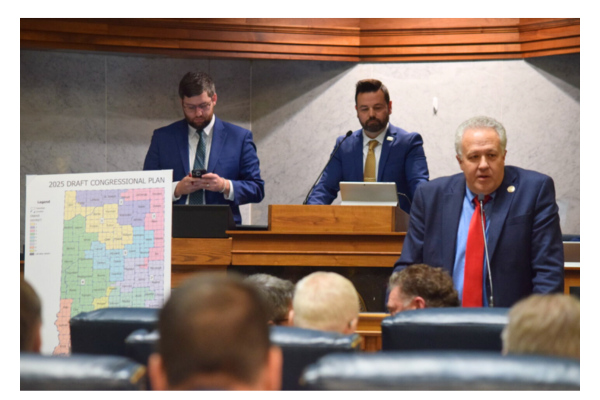
The Indiana Senate this month defied the wishes of President Donald Trump — despite a protracted national pressure campaign — when lawmakers there rejected a mid-census redraw of the state’s congressional maps.
The proposed maps were explicitly designed to bolster the GOP’s hold on the U.S. House in the 2026 midterm elections.
Trump kicked off the redistricting arms race in July, when he directed Texas to create five more GOP seats.
We began tracking the initiative: Vice President JD Vance’s visits to Indianapolis, Hoosier Republicans’ travel to the U.S. Capitol, closed-door caucuses and more.
The team logged gradual changes in Indiana Gov. Mike Braun’s stance as his wait-and-see approach shifted toward a special session dedicated to the redistricting effort.
And we covered lawmakers’ will-they-or-won’t-they decision on reconvening, which culminated in an early start to the 2026 session. The whole team — including new Deputy Editor Tom Davies — pitched in to analyze the proposed maps, man lengthy public hearings and probably irritate reticent lawmakers in our efforts to bring you the latest.
The Senate’s 31-19 defeat of the maps means the idea can’t be reconsidered until the 2027 session. Now, we’re following the short– and long-term political fallout.
2. Sheriff scrutiny
ICC’s mission, to fill in gaps in state-level coverage, sometimes takes us beyond the Government Center campus in Indianapolis.
Senior Reporter Casey Smith tackled the complicated story of a state investigation into a county sheriff’s alleged wrongdoing, finding that the only person disciplined was the detective who pursued the case.
And she followed up, reporting that a state law enforcement board is considering whether Dubois County Sheriff Tom Kleinhelter — who is accused of mishandling jail commissary funds and more — should be stripped of his police credentials.
Smith also kept tabs on a series she began last year on wrongdoing by former Clark County Sheriff Jamey Noel, which prompted greater state oversight of jail commissary funds.
She catalogued the court-sanctioned sales of Noel’s misbegotten property — complete with pictures of his auctioned luxury cars and self-branded merchandise — as the disgraced man begins making good on restitution orders.
3. Economic development sunlight
Just before she went back east, landing at a sister outlet in Pennsylvania, former ICC Senior Reporter Whitney Downard wrapped up a contentious chapter for the state’s embattled economic development authority.
Over the spring, Braun’s administration launched a forensic analysis into spending by the Indiana Economic Development Corp. and its relationship with several partners. Downard broke down the substantial report, released in the fall, and reaction to it.
The results prompted a spate of accountability-oriented changes. IEDC’s board has revamped its conflict-of-interest policies, with screened members exiting the room for certain projects, and investment policies. Only the full board makes binding votes now. And the quasi-public agency’s nonprofit arm is going to “wind down,” officials have said, although that hasn’t been completed.
Braun wants to move on from damage control. IEDC is revving up a renewed focus on regional development.
4. Indiana governor’s first year
It was a tumultuous first year in office for Braun, who was inaugurated mid-January — after the General Assembly reconvened for legislative business.
Amid slower revenue growth, he led the push to slash state spending, signing the state’s latest biennial budget into law in April.
But he spent much of his political capital on a property tax relief plan that lawmakers weakened and subsumed into a behemoth local government finance law. Revisions are expected this session.
Despite mixed results on his property tax agenda and defeat on redistricting, Braun said year one still featured plenty of wins, during a sit-down interview with Reporter Leslie Bonilla Muñiz.
He highlighted the remake of IEDC and the commission that regulates utility services; the cuts to agency spending and a leadership reorganization; and boosts to education and public safety.
5. Your mileage may vary
Braun’s ascension to the Governor’s Residence in Indianapolis also sparked scrutiny on upgrades made to his family home in southwestern Indiana and frequent travel between the two.
Downard broke the news of the state’s plans to spend at least $118,000 on security improvements to the house in Jasper. The work included a gravel helipad, fencing, gates and a trailer for a round-the-clock security detail staffed by Indiana State Police.
Braun is the first governor in recent decades to reside outside of central Indiana while in office. Former Govs. Eric Holcomb and Mike Pence made the Indianapolis estate their primary residence, while former Gov. Mitch Daniels split his time between that building and his home in Carmel.
Jasper and Indianapolis are located more than two hours apart by car — or, just 45 minutes by helicopter.
Downard also reported Braun took 11 helicopter rides to and from his Jasper home over about six months, costing almost $24,000. The state said that it would have incurred those costs regardless, because Indiana State Police pilots needed the flight hours to satisfy federal license maintenance requirements.
6. License plates boost budgets
That metal plate fastened to your vehicle can bring in big bucks for nonprofit groups and the state.
Bonilla Muñiz found Hoosiers pumped almost $200 million into charitable causes over two decades — just by buying and renewing special group recognition license plates.
But recently toughened sales and signature requirements may force organizations out of the program and block prospective participants from joining.
Seen those all-black plates on the road? Smith got a preview of the “blackout” designs, which have already generated millions of dollars for the state.
7. Former administration leader disciplined
Smith has also been on top of wrongdoing by one-time Public Safety Secretary Jennifer-Ruth Green, who resigned in September, repeatedly breaking news along the way.
The Indiana State Ethics Commission this month approved a settlement featuring a $10,000 civil fine for Green, finding she violated political activity and misuse of state property rules.
That approval closed the ethics case against Green, but potential criminal charges remain under review by the Marion County Prosecutor’s Office, Smith reported.
Smith and ICC Editor Niki Kelly were the first to report on a remediation document revealing Green was the subject of a state inspector general probe prior to her abrupt departure.
She’s still running for Congress again, though. Her campaign has called the investigation a “politically motivated sham.”
8. Social service cuts
The spending cuts undertaken after the lackluster springtime revenue forecast are hitting social services for impoverished Hoosiers, ICC reporting shows.
Indiana enrollment in Medicaid, the low-income health care program, has dropped by about 300,000 people throughout the year, totaling 1.7 million in November, according to the latest forecast, delivered this month. The dip comes as officials continue aggressive post-pandemic eligibility checks.
Lawmakers have also approved cost-controlling work mandates for the Healthy Indiana Plan, a Medicaid-expansion health insurance program for 700,000 low- to moderate-income Hoosiers. But it won’t take effect until 2027, when a federal law imposes such requirements on expansion enrollees nationwide.
And there are big changes coming for providers serving the 8,000 children who receive autism therapy through Medicaid. The state plans to reduce its hourly rate 10% and is considering other cost-cutting strategies for the fast-growing program.
Families who need help paying for child care have also struggled, as a state freeze on vouchers enters its second year. It’s creating enrollment crunches for providers, also hard-hit by the state’s significantly lower reimbursement rates.
Indiana additionally opted out of a summer meal program for hungry low-income schoolchildren. Downard broke that story, then followed up, reporting that a key agency and Lt. Gov. Micah Beckwith blamed the miss on poor planning by Holcomb’s outgoing administration.
9. Educational changes
Indiana schools saw mixed results this year.
Third-graders produced a historic jump in reading scores, but about 3,000 were held back for not meeting literacy proficiency standards.
Fewer students are missing large chunks of school, but chronic absenteeism rates still remain well above pre-pandemic levels. Smith, ICC’s education guru, broke down what a recent absenteeism law does.
Indiana has asked the U.S. Department of Education for permission to combine funding from 15-plus federal programs into one block grant, overhauling how the state spends and tracks billions in education aid.
Public higher educational institutions, meanwhile, reported enrollment gains but a lower college-going rate. They also axed or restructured hundreds of degree programs under a recent state law, and recorded millions of dollars in canceled federal research grants.
10. Two more executions
Indiana ended its 15-year execution pause last year after securing a new lethal drug. This year, the state put two more men to death.
Roy Lee Ward was executed in October for the 2001 rape and murder of teenager Stacy Payne. Benjamin Ritchie was executed in May, nearly 25 years after he killed Beech Grove law enforcement officer William Toney.
Details on both were sparse; no reporters were permitted to witness.
Braun confirmed over the summer that Indiana spent more than $1 million on execution drugs. Three doses were purchased for $900,000 under Holcomb’s administration. Only one was utilized; the other two doses expired without use. Braun’s administration spent $275,000 on a fourth dose, used for Ritchie’s execution.
But his office has refused to disclose exactly how much the state paid for the latest three sets of lethal injection drugs purchased by the Department of Correction in recent months. At least one of those doses was expected to be used for Ward’s execution. The remaining sets expired at the end of October, according to court documents.
Five men remain on Indiana’s death row, but only four are currently considered competent for execution. No new inmates have been added since 2013, and capital prosecutions remain rare and costly.
Smith reports lawmakers are exploring other execution methods in new legislation. Braun told ICC he’ll “look at” whatever “comes up,” but said such measures “don’t rise to the level of” kitchen-table issues.
* * *
The Indiana Capital Chronicle is an independent, nonprofit news organization dedicated to giving Hoosiers a comprehensive look inside state government, policy and elections. The site combines daily coverage with in-depth scrutiny, political awareness and insightful commentary.