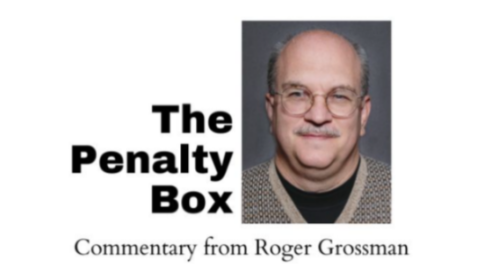
Roger Grossman
News Now Warsaw
College sports have run amok.
What is currently happening with the level of organized athletics in between high school and the pros is exactly what those of us who truly care about college athletics have been fearing for several years.
Be clear, the path that college sports is on is straight downhill, and at the bottom of it is a fiery pit.
And everyone on the chartered bus careening down the path is laughing and counting their money with no regard for the danger that is ahead.
No one is in the driver’s seat, and no one seems to notice…or care.
Why do I say this?
Well, let’s start with the transfer portal, shall we?
While Michigan men’s basketball players were still walking around the game floor of Lucas Oil Stadium after winning the national championship, the men’s basketball transfer portal opened for players to plug their names into. That would make them available to any school that wanted them and anywhere they’d want to go.
Hundreds of players had already made public what their plans were, and by the time the dust settled two days later, almost 6-thousand college basketball players from Division I rosters had put their names into the portal.
For those of you asking the question, the answer is “that’s over half the players in Division I college basketball.”
The same thing happened the night of the women’s national championship game. The confetti was still wafting from the rafters in Phoenix and the transfer portal was filling up. About 20-percent of them went into the portal.
Think about it — the two basketball coaching staffs that just achieved their greatest accomplishment had to choose between celebrating with their players and families the highest point of their careers or beginning to rebuild their roster to do it again next year.
What kind of choice is that?
Who are the kids who enter the transfer portal?
I don’t think you can lump them all into a single category. You could, but it would be patently unfair.
Yes, there are kids who are unhappy with their role or playing time and they are looking to move somewhere that they will get more time, more involvement and the potential to be a bigger contributor than they are currently.
There are also kids, like Markus Burton of Notre Dame and Penn High School fame, who look around and say, “I’m on a team that has a record of 28-36 over my two seasons, my teammates all entered the portal, why should I stay in South Bend?”
Others transfer to change levels of play.
For example, a player at an NAIA school may be doing really well and is looking for a chance to move up to an NCAA school. Elijah Malone of Grace College, moving to Colorado University, is a great example of this.
You can understand all of those mindsets, right?
But there are also kids who are leaving for the money.
No, we aren’t talking about scholarship money. This is cold, hard cash we are talking about—millions of dollars for some of them.
It’s money that’s called “Name, Image and Likeness” money, but that is most certainly not what it really is.
The concept of “NIL” was that players would be allowed to make extra money during their college years by doing endorsements and similar things and getting paid for doing them. Under the old rules, that was a massive no-no and would get you suspended by the NCAA for a while.
The purpose of that restriction was to prevent fraudulent “deals” from being put in place, which would give athletes cash and other benefits that were not permissible.
Heck, college kids are signing contracts with colleges now for the money.
And they are leaving their first school after one year to go to another school simply because the “NIL” deal at the second school is sweeter than the first.
Add to that the disgraceful campaign the NCAA ran during March Madness, informing us that they are monitoring social media threats against college athletes based on gambling.
Gamblers are getting upset when little Johnny goes 3-15 from the field in a big game they put big money on and lose it. They are getting aggressive on social media about it.
I feel terrible about that, but this has been the logical outcome from the start. I warned you all that students who are now getting paid to play were going to feel more pressure for their performance than ever before, and that gamblers were not going to sit quietly while their cash flies out of their pockets because a quarterback keeps throwing the ball to the wrong team.
Then, on the scorer’s tables at the game venues, you see messages like “98-percent of student athletes will go pro in something other than sports.”
That’s not true!
Everyone you are watching is getting paid something for playing — by definition, that makes them professional athletes.
The only real student athletes on college campuses are the ones who go all four years and become teachers, pharmacists and nurses.
Everyone else is just riding the bus down that hill into the pit.